
Note: This post reflects the situation as of March 2016. The law has moved on since then, including the GDPR (2018) and the CJEU ruling in the “Fashion ID” case (2019).
A few days ago, attorney Thomas Schwenke published an excellent article on a ruling by the Düsseldorf Regional Court on allfacebook.de, in which he lays out the consequences of this terrible verdict in quite some detail. Unfortunately, the article gets a bit legalistic in some places, perhaps a bit too technical in others, and in the end the average website owner is left with a few open questions. Specifically: Which Facebook share or like buttons am I actually still allowed to use? That’s the question this article is meant to answer.
Dynamic vs. Static
As early as the second paragraph, Schwenke says that this ruling affects “practically the entire dynamic internet.” That’s true, but at the same time a bit cryptic. After all, who even knows what the “dynamic internet” is supposed to be? Here’s my definition:
A “static page” looks exactly the same for every visitor. That means if you write a blog post like this one and then add a few images, it makes absolutely no difference whether your visitor is logged in to Facebook (or any other site) or not, whether they’re from Germany or France or anywhere else, and whether they’re browsing on a MacBook or a Windows PC – the page always looks exactly the same.

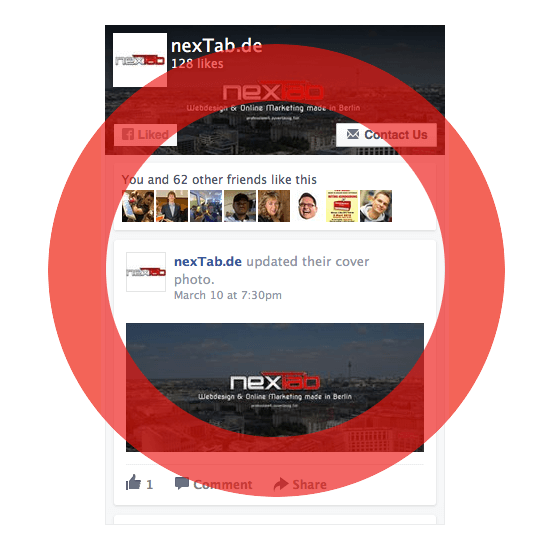
A “dynamic page” responds “interactively” to the visitor. What this means is that a dynamic element can look different for each visitor. A very typical example (and the central element of the ruling) is the Facebook Page Plugin, which you can see in the screenshot on the right. Mind you: a SCREENSHOT!
This is what I would see at this very moment if I embedded this box. I can tell from it that the nexTab.de Facebook page currently has 128 likes. If you decided to like the page as well right now (assuming you’re not a fan yet), the number in the plugin would automatically update to 129, but not in this screenshot – after all, it’s “just an image” (in other words, a static element).
I can also see that I already “like” the page (obviously) as well as the profile pictures of some of my friends, which isn’t all that important in this case. But if I were looking at the Page Plugin of… let’s say “Zalando,” it might show me that my wife already likes the page, along with lots of my other friends, and in a way that already inspires a bit of trust.
I could write a little psychological treatise now, but I think most readers will understand that people put more stock in their own friends’ opinions than in a boring statistic like “50,000 people like Zalando.” The usual reaction to that is “So what?” But if your own wife likes Zalando, that’s instantly far more convincing – after all, I have to stand by my wife (otherwise she’d probably order 10 pairs of shoes right away out of revenge…).
Once again: This is a screenshot. If it were the “real” Page Plugin and YOU visited the page, it would probably show different profile pictures. And of course, the “Liked” might not be grayed out because you haven’t liked the page yet (shame on you!).
What’s the problem with dynamic elements?
For a Facebook Page Plugin to show me “live” how many of my friends like the page (and whether I like it myself, etc.), Facebook has to feed this data in live whenever I open the page on which the plugin is embedded. On the other hand, this data is, logically, tailored to ME. So Facebook also has to understand that I – Oliver Gehrmann, who also has a Facebook account – am visiting this page. According to the court’s ruling, that is exactly where the problem lies.
How is it technically possible for Facebook to match me, “just some website visitor,” to my specific Facebook profile? That’s usually done with a cookie.
What is a cookie, anyway?
A cookie is a small file that your web browser stores on your computer. Typically, it’s a text file containing a few pieces of information. On the one hand, cookies make browsing the web a lot easier, because a cookie could, for example, store the information that I’m logged in to Facebook with the username “soulwarrior.” When I then visit Facebook, I don’t have to go through the hassle of logging in first, since the cookie “proves” that I’m logged in with a certain account (some readers will already suspect that cookies can also be used for mischief, and yes, that’s definitely the case).
Since most sites you can log in to in some way work with cookies, doing without them usually means a noticeable loss of comfort when browsing the web. I mean, who wants to log in again every time they visit Facebook / Pizza.de / Amazon.de / etc.?
Unfortunately, cookies aren’t entirely harmless when it comes to privacy. Because once I’ve logged in to Facebook, the cookie sits on my computer. Mind you: Even after I’ve logged out. (This may change at some point, but technically it’s no problem at all to have a cookie do that job.)
If I now visit a page on which the Facebook Page Plugin is embedded, we’ve already learned that this plugin pulls data from Facebook and, of course, also sends some to Facebook. And this can include the information that a visitor to the page has the cookie in their browser that says they were once logged in to Facebook with the username “soulwarrior.” The plugin can then do its job and show me live whether I already like the page promoted by the plugin, show me the faces of a few friends, and so on.

The bottom line: As long as the cookie is on my computer, Facebook knows fairly precisely which pages I visit, as long as some dynamic element (a Facebook Like button or the Page Plugin) is embedded on them.
So what am I actually allowed to do (and what not)?
We’ve spent a lot of words on the problems now, but we still haven’t cleared up what’s still allowed. The answer is fairly simple: all static elements.
More specifically:
- A “normal link” to your Facebook page is no problem at all.
-> Example: At the very bottom of our website, in the footer, you’ll find the Facebook icon. If you click it, you’ll be taken to Facebook. A completely normal link is entirely unproblematic, because it doesn’t send any data to Facebook live.
-> In the code, normal links always look roughly like this:<a href="the address">the link name</a> - A “share button” that opens a new window is also harmless

This example is quite interesting, because you can even see counters on the buttons themselves. They show how often the article has already been shared. Shouldn’t that be a “dynamic element”?
Yes and no; the plugin fetches these counts from Facebook and LinkedIn at regular intervals. No personal data is analyzed in the process; it really ONLY queries the number. So from a privacy standpoint this is harmless, because there’s no way of telling WHICH USER exactly opened the page. So it’s a more or less dynamic element, but it doesn’t give us any headaches.

It’s always fairly easy to check. If a new window opens with “sharer.php” in the address bar, then in 95% of all cases it’s a static element (a completely normal link). If I were able to share a link with just one click (or if no new window opens), that points to an integration where Facebook already receives data as soon as you enter the page, and so that would be problematic again.
- Images are harmless; in the code they always look like this:
<img src="image-url" alt="alternative image text" />
- In principle, EVERYTHING that works with an “iframe” in the code is problematic!
-> An iFrame is like a “window into another site” (typically Facebook). So data is always fed in live from somewhere else here, and of course in the other direction as well, and that’s very questionable again for privacy reasons. - Most things that work with JavaScript are problematic!
-> This includes, for example, Facebook’s “conversion pixels.” Their very specific purpose is to inform Facebook when a visitor performs a certain action, and naturally Facebook also wants to know which user that is (which is again often done with the cookie).
-> You can recognize these elements in the code by “script.”
My own opinion
At the beginning, I already spoke of a “terrible verdict.” I’m aware that I don’t take privacy quite as seriously as some of my friends do. That certainly has a lot to do with the fact that I understand a fair amount about the technical possibilities the internet brings with it. Let’s say you go to Google and enter a search term. You find an interesting site and click on it. That site uses Google Analytics, so Google now knows that the person with a certain IP address (who is also the same person who was just searching on Google.de) has landed on this site. If you click through from this site to Amazon, Google still knows (provided Amazon also uses Google Analytics) who’s browsing here. And that’s even though you haven’t been on Google at all in the meantime.
Take the example a bit further and you’ll know why the ads you see on Google mostly look highly interesting. After all, Google knows VERY WELL what you like (and what you don’t, because you practically never visit those sites).
There is no anonymity on the web.
At least not for the average computer user.
German judges can twist and turn all they want, but at the end of the day it changes very little about the outcome. If users want their data to be truly protected, they have to make an effort and, for example, rely on software that routes traffic through a proxy server, encrypts absolutely everything that’s sent back and forth between their computer and the servers on the web, etc.
In the eyes of some people it may be quite commendable to at least try to make it harder for companies like Facebook to analyze user behavior, but at the end of the day, a ruling like this only achieves one thing: numerous “regular website owners” get fleeced by lawyers sending cease-and-desist letters. Sure, that creates jobs too, but I still don’t think it makes sense.
In my view, it would make much more sense to put fewer legal obstacles in people’s way and instead educate those who REALLY care about protecting their data. Sure, every idiot on the street will tell you, if you hold a microphone in front of their mouth, that it’s “really important to them that they can’t be spied on.” But since the average citizen makes no effort whatsoever to REALLY keep their own data private and uses apps / websites like WhatsApp or Facebook, the courts shouldn’t chase after them endlessly, because it doesn’t make any difference anyway. Even if no Facebook Page Plugin is used anymore, Facebook knows exactly what you like and what you do. Unless you do something about it. In that sense, the ruling is out of touch with reality in my eyes, and it achieves absolutely nothing – except the cease-and-desist letters already mentioned and unnecessary paperwork. But hey, that’s what Germany is for…
On this subject, here’s another excellent (and entertaining) segment by John Oliver on data encryption (which is closely related to the topics discussed here):
Watch on YouTube: Encryption – Last Week Tonight with John Oliver (HBO)



Leave a Reply